Get better sleep.
Snoring and Sleep Apnea: A Common Problem
Snoring is a highly prevalent problem in the United States and more than 35 million individuals snore on a regular basis. Snoring can be consistently problematic every night or intermittent. Significantly loud and socially problematic sleep disruption of the snorer and their bed partner can lead to a whole host of social and medical consequences. Almost a third of adults over the age of 55 snore at least a few times a week. Those who are 55 to 64 tend to snore greater than 40% of the time. Men are significantly much more likely the snore than women.
COMMON FACTORS FOR SNORERS
Those who snore are more often male and tend to be overweight. Snoring occurs more and more as we age and as we gain weight. With snoring, sleep fragmentation occurs with loss of restorative sleep, which ultimately results in tiredness during the day and a decrease in daytime function. The most common problems associated with snoring include heart disease, daytime tiredness and cognitive dysfunction. Importantly, nearly half of all individuals who snore also have obstructive sleep apnea syndrome.
HOW DOES SNORING HAPPEN?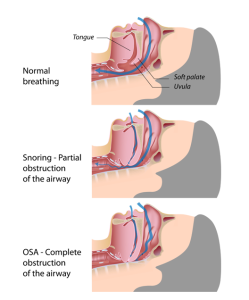
When we fall asleep, we generally are silent without snoring noises, just soft gentle breathing which does not disrupt the individual or the individual’s bed partner. However, during sleep, the airway changes and collapses, particularly as we progress into the deeper stages of REM sleep.
Often, the muscles of the upper throat will relax and the tongue will fall backwards, occluding the back of throat. When there is narrowing, the structures of the back of the throat, particularly the soft palate, will start to vibrate, causing loud snoring noises. Although the sounds tend to come from the soft palate, the base of tongue and its fullness and backward positioning also contributes to the narrow airway. Essentially, snoring is a hallmark of closure or narrowness of the upper airway. Snoring is generally louder on inhalation, but exhalation also can cause loud vibratory noises. When there is complete collapse or occlusion of the throat the result is full cessation of breathing, which is essentially the hallmark for obstructive sleep apnea. Apnea essentially means that there is no further air flowing in or out of the throat, mouth or nose.
EXACERBATING FACTORS
Probably the most common exacerbating factor for snoring is weight gain and frank obesity. Also, the normal aging process will predispose to more relaxation of the upper throat muscles, predisposing to collapse and loud snoring. Upper airway structural and anatomic obstructive abnormalities can lead to snoring and these include obstruction in the nose, oral cavity, and deeper oropharynx regions.
The following are anatomical findings associated with snoring:
- Enlarged palatine tonsil.
- Enlarged adenoid tonsil.
- Elongated, redundant, and floppy soft palate and uvula.
- Large tongue.
- Narrow oropharyngeal airway.
- Retrognathia (weak chin).
- Nasal septal deviation.
- Nasal polyposis.
- Nasal obstruction due to rhinitis or allergies.
- Large neck (>18 inches in circumference)
- Combinations of the above.
The body position during sleep can also influence snoring. When sleeping on one’s back, the jaw and soft tissues of the throat will tend to displace backwards rendering closure of the throat and louder snoring. Sleeping on the side tends to diminish snoring in many instances but not always. Nasal obstruction by itself lends to a greater propensity for opening of the mouth, and with mouth opening, more closure of the throat will ensue rendering more snoring. Medications and alcohol can change the tone in the throat muscles and render a greater propensity for relaxation and closure with resultant snoring. Individuals who have a neck girth greater than 17 to 18 inches tend also to be snorers.
SNORING OR SNORING PLUS SLEEP APNEA?
Approximately half of individuals who snore will have elements of obstructive sleep apnea syndrome, which is a medically potentially serious condition. Common symptoms of obstructive sleep apnea syndrome include the following:
- Morning headaches.
- Daytime fatigue, tiredness, and need to take naps.
- Weight gain.
- Waking up late in the morning and not feeling completely rested.
- Waking up in the middle of the night feeling confused.
- Waking up in the middle of the night, choking or stopping breathing.
- Poor memory, decreased concentration.
- Erectile dysfunction.
- Depression.
- Reflux.
SLEEP APNEA
Loud snoring can be a simple indication of obstructive sleep apnea syndrome. Approximately half individuals who snore also have obstructive sleep apnea syndrome, therefore, if you snore, evaluation is recommended for all. Consultation with your physician is important. Evaluation with a Otolaryngologist should include history and physical examination with specific attention to the upper airway anatomy and patency. This includes examination of the nose, oral cavity, oropharynx, and deeper hypopharynx and larynx structures. Commonly, those individuals who have a history of stopping and pausing the breathing at nighttime, loud snoring, daytime hypersomnolence, and a narrow airway findings should undergo a sleep study. Sleep studies indicate the degree of disruption of sleep at nighttime and the level of sleep apnea if present.
The consequences of untreated sleep apnea are significant. Manifestations of active sleep apnea include the following:
- Daytime hypersomulence and fatigue
- Increased risk of motor vehicle accident.
- Erectile dysfunction
- Increased risk of stroke
- Increase risk of heart attack
- Hypertension
- Worsening obesity (due to lack of energy and exercise)
- Loss of full life expectancy
HIDDEN PROBLEM
Most commonly the bed partner will significantly complain of the loud snoring at nighttime which stimulates the effort to seek out treatment. Often times however, individuals who do not have a regular bed partner will not know about their snoring condition, but will find out about their snoring only when going on a business trip and sharing a room with a business associate. Another common occurrence lending towards determining the problem of snoring occurs when the undiagnosed snorer camps with friends and family and sleeps in the same tent.
Those who snore are not necessarily stimulated to seek out assessment and treatment. The bed partner is a common reason that individuals seek medical help. However, despite the bed partner’s efforts, most individuals with snoring or sleep apnea do not seek out help. Thus the majority of individuals in the United States with obstructive sleep apnea syndrome do not even know they have a problem. This undiagnosed medical problem is only getting worse as the US population becomes older and more obese.
SIMPLE TREATMENT
Those individuals who suffer from snoring and disruptive sleep should immediately attempt simple measures to try and improve their overall condition. These include:
- Weight loss and rigid disciplined diet (remove sugar from the diet).
- Adjust sleep positioning, sleep on one side, avoid sleeping on one’s back.
- Significant exercise to assist in losing weight.
- Abstain from alcohol
- Avoid sedating medications such as sleeping pills, tranquilizers or antihistamines.
- Establish regular sleeping times and keep to the same pattern.
INTERVENTIONAL OPTIONS FOR SNORING
Various surgical options are available to individuals who snore. The ultimate success of reducing or curing snoring is greater than 90% for individuals who undergo appropriately targeted treatment.
- Septoplasty
- Turbinate reduction
- Radiofrequency reduction of turbinates
- Laser assisted palatoplasty
- Uvulopalatopharyngoplasty
- Radiofrequency reduction of soft palate
- Tongue suspension
- Pillar placement to soft palate
INTERVENTIONAL OPTIONS FOR SNORING WITH OBSTRUCTIVE SLEEP APNEA
The mainstay treatment for Sleep apnea is CPAP, or positive airway pressure application every night. When this works, patients will have a significant improvement in the quality of their lives. When it does not work, or when compliance with the device is poor, surgical and interventional options are needed.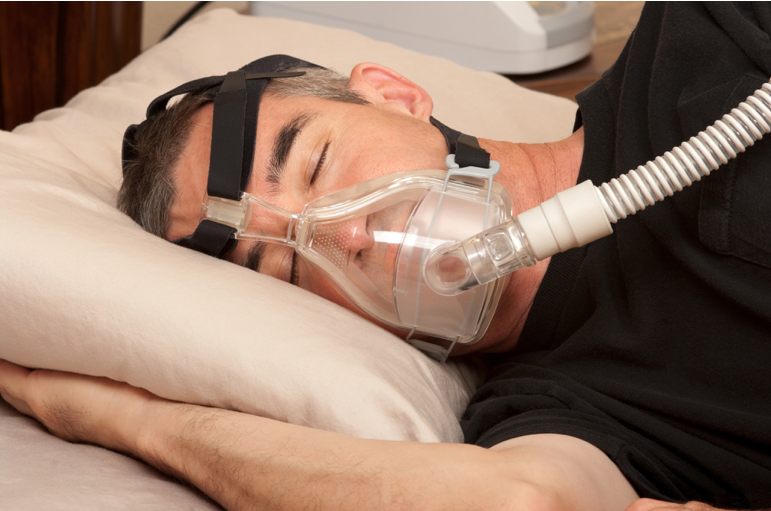
Snoring Surgery
Although the ultimate success of reducing or curing snoring with surgery is high, surgery success to resolve sleep apnea is variable. The treatment options for snoring with sleep apnea include the following:
- Septoplasty
- Turbinate reduction
- Radiofrequency reduction of turbinates
- Laser assisted palatoplasty
- Uvulopharyngopalatoplasty
- Radiofrequency reduction of soft palate
- Tongue suspension
- Pillar placement to soft palate
- Genioglossus advancement
- Hyoid transposition
- Tongue reduction
- Weight loss procedures (gastric balloon placement, gastric sleeve)
- Maxillo-mandibular advancement
For those individuals who are motivated and enthusiastic about achieving improvement or resolution of their disruptive sleeping condition will ultimately achieve good success, however, persistence and patience is required.
A Few Reasons to Choose Facial Beauty
Low Risk Procedures
Every procedure requires some for of anesthesia and traditionally this is a General Anesthesia, meaning you are completely knocked out. At Facial Beauty, we utilize cutting-edge local anesthesia procedures where you are not fully knocked out but completely comfortable. The advantage of Local Anesthesia that there are less complications & faster recovery time. Our procedures generally take from an hour and thirty minutes to no more than three hours, allowing us to dramatically reduce any risk involved in the procedure.


Limited Downtime
The biggest drawback to major facial surgery is the downtime. While recovery time can vary case by case, generally patients can return to work between seven to ten days after the procedure. We do everything we can for our patients to get you back to your family and back to your daily life of activity & exercise as soon as possible.
Simple & Affordable Financing
At Facial Beauty, we offer low monthly payment plans and pre-qualifications for any additional treatments, affordability has never been easier. If you’ve ever let financing stand in your way of a new you, come talk to us about options you may not know you had. We can even do pre-approvals over the phone so please feel free to contact us anytime.

David Santos MD, FACS
Dr David Santos was the Medical Director for Lifestyle Lift, responsible for hundreds of facelift surgeons and thousands of procedures. Having performed over 4,000 facelift procedures himself, Dr. Santos is committed to finding cutting edge techniques to reduce the risk and minimize the downtime of facelift procedures.
- Member American Board of Facial Plastic and Reconstructive Surgery
- Member American Board of Otolarnyngology – Head and Neck Surgery
- Member American Academy of Facial Plastic and Reconstructive Surgery